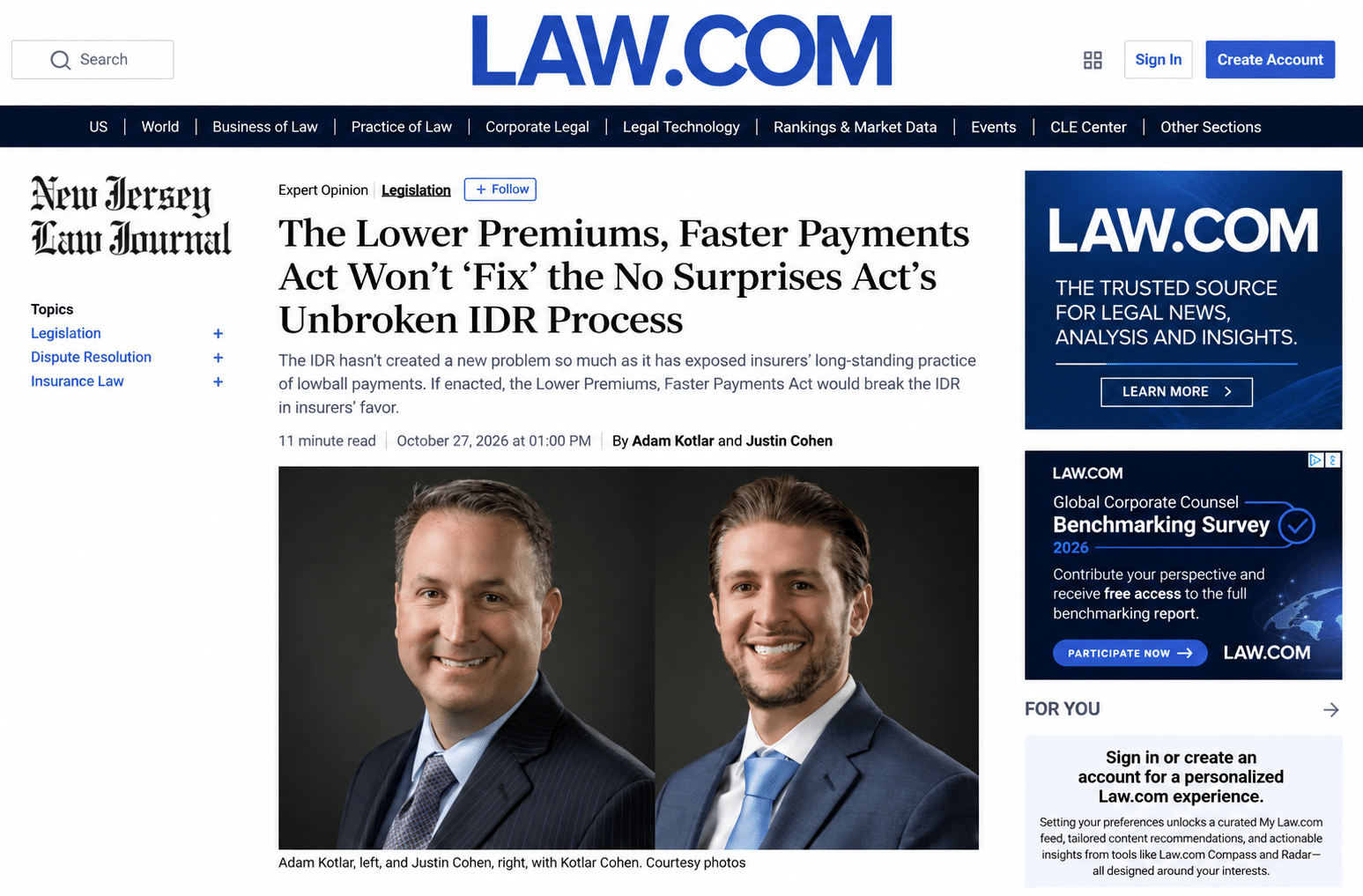
Adam Kotlar and Justin Cohen’s article, published October 27, 2026, examines the proposed Lower Premiums, Faster Payments Act and its potential impact on the No Surprises Act’s Independent Dispute Resolution (IDR) process.
The Lower Premiums, Faster Payments Act Won’t ‘Fix’ the No Surprises Act’s Unbroken IDR Process
In a billing dispute where we represented a medical provider under the federal No Surprises Act’s Independent Dispute Resolution (“IDR”) process, an insurer initially paid just $236 for a knee replacement. That amount was intended to cover a double-board-certified orthopedic surgeon screening a patient, planning the surgery, performing the multi-hour procedure, and managing all follow-up care. A licensed plumber commands more on the open market to fix a leaky kitchen faucet.
Offers like that—which are all too common—account for why providers win the lion’s share of disputes brought under the IDR. Yet insurers who cite providers’ high win rates as proof the IDR needs reform never mention their lowball offers.
In a recent CBS News report, the network claimed the No Surprises Act “spawned a lucrative arbitration industry with providers and specialized middlemen extracting payments far above benchmark billing rates,” which is “ultimately driving up healthcare costs for consumers.” The report cites Centers for Medicare & Medicaid Services (“CMS”) data showing that arbitrators ruled for providers in 85 percent of disputes decided in the second half of 2025.
Critics say this suggests the IDR process is broken—a message reaching politicians. On October 8, U.S. Rep. Frank Pallone Jr. (D-N.J.), one of the No Surprises Act’s authors, introduced the “Lower Premiums, Faster Payments Act.” This legislation would end IDR for services provided on or after January 1, 2028, and instead require insurers to pay contested out-of-network claims at their median contracted rate as of January 31, 2019, adjusted for inflation. This means the qualifying payment amount (“QPA”), an insurer’s median contracted rate for the same or similar service in the same geographic area, would become the final payment. The bill would also bar courts from reviewing how insurers calculate those rates.
There’s nothing inherently wrong with the IDR. Calls to end it ignore insurers’ lowball efforts, and wrongly attribute providers’ winning rate to bad actors gaming the system. The IDR hasn’t created a new problem so much as it has exposed insurers’ long-standing practice of lowball payments. If enacted, the Lower Premiums, Faster Payments Act would break the IDR in insurers’ favor.
Providers Have High IDR Win Rates Because Insurers Do Not Negotiate in Good Faith
The No Surprises Act takes patients out of billing disputes between providers and insurers. After an insurer makes an initial payment to a provider or denies their bill, the parties must negotiate for 30 business days.
If negotiations fail, either party may initiate the IDR process. During that process, each side submits a proposed payment amount. A government-certified arbitrator must select one, weighing the factors set out in the statute. The award is binding, and the No Surprises Act requires payment to be due “not later than 30 days after the date on which such determination is made.”
This “baseball-style” format discourages inflated and lowball offers alike, and arbitrators must not have a conflict of interest with either party. That an arbitrator picks the provider’s number 85 percent of the time shows that the system works as intended. Insurers “lose” so often because their offers are unreasonable, as in the example above regarding a $236 knee replacement payment.
Accusations that providers are being rewarded for submitting exorbitant figures don’t hold up under any scrutiny. Insurers point out that arbitrators often award providers payments that run several times the QPA. But a July 2021 interim final rule issued by the U.S. Department of Health & Human Services, the U.S. Department of Labor, and the U.S. Department of the Treasury, allowed “ghost rates” to be included in the QPA calculation. Ghost rates are contracted rates for services a provider never actually performs. Consider a podiatrist who provides only nonsurgical care. An insurer can contract with that podiatrist at a fair rate for office visits while assigning token rates to surgical codes the podiatrist never bills. Those phantom surgical rates then flow into the QPA, dragging down the benchmark arbitrators see when a surgeon disputes payment for the same procedure.
If insurers offered fair amounts for services provided and arbitrators selected those figures, providers would lose more often, and over time, insurers’ win rates would move closer to providers’ win rates. But insurers aren’t offering fair amounts—if they even offer an amount. In 2025, insurers lost by default—that is, they refused to participate in the IDR process—in 24.5 percent of IDR line items, according to a September 2026 analysis of CMS data by the American Society of Anesthesiologists, the American College of Emergency Physicians, and the American College of Radiology. That same analysis found that insurers submitted an offer of $1 or less in another 8.2 percent of cases.
In our firm’s experience, settlement resolves fewer than 1 percent of cases during the open negotiation period, and insurers pay fewer than 1 percent of IDR awards within the statutory 30-day deadline. When roughly a third of all line items involve an insurer that submitted no offer or a dollar or less, and the vast majority of awards are paid late, if at all, it is clear who is breaking the IDR process.
Insurers Are Responsible for What They Deem an Excessive Number of Payment Disputes
Critics of the IDR process also point to the millions of disputes filed each year, far more than regulators anticipated, and the handful of large firms that file a disproportionate share.
Many providers have no choice in which patients they treat. Under the Emergency Medical Treatment and Labor Act, hospitals and the emergency physicians, anesthesiologists, and radiologists who staff them must screen and stabilize every patient who comes through the emergency department, regardless of insurance. When insurers underpay providers who treat a high volume of patients, those providers will file a high volume of disputes.
Courts have not found that providers are abusing the IDR process. Insurers have brought lawsuits alleging that certain awards have resulted from high-volume filers abusing the process. None has succeeded to date, and courts have held that insurers cannot re-litigate an award simply because they dislike it. See, e.g., Blue Cross Blue Shield of Texas v. HaloMD, No. 25-cv-00132 (E.D. Tex., dismissed May 22, 2026), Aetna v. Radiology Partners, No. 24-cv-1343 (M.D. Fla., dismissed Apr. 16, 2026), Anthem Blue Cross v. HaloMD, No. 25-cv-01467 (C.D. Cal., dismissed Apr. 9, 2026).
Insurers complaining about dispute volume also overlook their own power to reduce it. In our experience, an insurer has roughly 90 days from when a provider opens negotiations to when it files its arbitration submission to pick up the phone and resolve a claim. Insurers squander that window, lose arbitration, pay late, and then claim providers prevented them from reaching a fair deal.
Making matters worse for providers, the Fifth Circuit held in Guardian Flight, L.L.C. v. Health Care Service Corp., 140 F.4th 271 (5th Cir. 2025), that the No Surprises Act does not create a private right of action to enforce IDR awards in federal court. The Supreme Court declined to review that decision in January 2026. Thus, providers must rely on federal agencies to collect their IDR awards. Even before that ruling, a 2023 survey of over 48,000 clinicians by Americans for Fair Health Care found that 52 percent of IDR awards had not been paid. Rep. Pallone says the arbitration process “is clearly not working,” but what’s not working is that it places responsibilities on insurers that they aren’t fulfilling.
Critics also blame IDR awards for rising premiums. IDR payouts totaled roughly $15 billion in 2025, according to the Wall Street Journal. Even if every dollar were excess, that is about 1 percent of the more than $1.4 trillion Americans spend each year through private health insurance.
The Lower Premiums, Faster Payments Act Would Tip the IDR Scale Toward Insurers
Under the guise of “reform,” the Lower Premiums, Faster Payments Act would introduce several problems in the IDR and ultimately tip the scales in insurers’ favor.
First, using a median in-network rate (i.e., the QPA) in lieu of an arbitrated figure compounds the unfairness to physicians under the guise of neutrality. A physician willing to accept an insurer’s median in-network rate would already be in network. Paying out-of-network physicians that same median forces them to accept a price they rejected.
In addition, in-network rates do not account for a procedure’s difficulty for a particular patient. A cervical fusion on a morbidly obese smoker with long-standing diabetes is harder and riskier than the same procedure on a young, healthy nonsmoker.
The No Surprises Act accounts for this by requiring arbitrators to consider patient acuity, service complexity, and a provider’s training, experience, and outcomes. The Lower Premiums, Faster Payments Act reduces the discretion, professional judgment, and skill inherent in medical practice to a rote formula.
Even FAIR Health, an independent nonprofit that compiles in-network and out-of-network claims data, would be a more objective yardstick than an insurer’s own contracts, but that would still mean relying on a formula. No formula can capture what a CPT (i.e., a medical billing code) leaves out. That is why Congress left the final call to an independent arbitrator.
Second, the Lower Premiums, Faster Payments Act would let insurers keep rigging the system.
Under 42 U.S.C. § 300gg-111(c)(5)(C), IDR arbitrators must consider the QPA in choosing between offers. In our experience, insurers have played “hide the ball” with the underlying data, refusing to disclose what goes into the QPA calculation. Courts have now confirmed what providers long believed: the QPA rules let insurers lower the benchmark rate before arbitration even began, leaving arbitrators to weigh a benchmark that did not reflect what actual services were worth.
This past summer, the en banc Fifth Circuit held in Texas Medical Association v. HHS, No. 23-40605 (5th Cir. Aug. 11, 2026), that the No Surprises Act’s text did not authorize including ghost rates in the QPA and that doing so resulted in QPAs that were “artificially low.” The court pointed to lopsided arbitration results as additional evidence that QPAs were artificially low, the opposite of the inference the IDR’s critics draw from the same numbers.
Insurers’ use of ghost rates shows why insurers’ benchmark calculations need an independent check. Yet, a mere two months after the Fifth Circuit found the QPA methodology unlawful, the Lower Premiums, Faster Payments Act would make that methodology immune from judicial review and remove the arbitrator who checks it.
Finally, the Lower Premiums, Faster Payments Act would upset patients’ and doctors’ ability to make independent choices.
Many physicians, including specialists and emergency physicians, are out of network because insurers would not offer terms that adequately compensate for their care. Paid the median in-network rate anyway, some will be pressured to join networks on insurers’ terms or stop offering complex procedures altogether.
Patients who purchase policies with an out-of-network benefit, often to preserve access to specialists or to have greater choice in an emergency, could see that option hollowed out. Patients with no out-of-network benefit who experience an emergency must sometimes undergo out-of-network treatment as a life-saving measure. The bill would treat these differently situated patients the same in the name of efficiency.
Congress Should Take Action, but Not by Enacting the Lower Premiums, Faster Payments Act
If insurers made reasonable IDR offers, providers would lose more arbitrations, and disputes would decline. Instead of seeking legislation that discards Congress’s design for independent dispute resolution of disagreements over payments for medical services, insurers should negotiate meaningfully before disputes reach an arbitrator, and pay awards on time when they lose.
Congress can—and should—do more than scuttle IDR for an insurer-friendly system through the Lower Premiums, Faster Payments Act. It can preserve the integrity of the IDR process by amending the No Surprises Act to create a private right of action to enforce legally binding awards and to require transparency in how the QPA is calculated to prevent the extended rate maneuvering the Fifth Circuit just stopped.
These actions, rather than replacing arbitration with an unreviewable benchmark, would be true reform.
Adam Kotlar is a founding partner at Kotlar Cohen. He is certified by the Supreme Court of New Jersey as a Civil Trial Attorney and as a Workers’ Compensation Attorney. Justin Cohen is also a founding partner at Kotlar Cohen. He is certified by the Supreme Court of New Jersey as a Workers’ Compensation Attorney. Both co-chair the firm’s No Surprises Act legal practice, representing physicians and medical groups in the statute’s Independent Dispute Resolution process. They can be reached at [email protected] and [email protected], respectively.
Reprinted with permission from the October 27, 2026 edition of The New Jersey Law Journal © 2026 ALM Media Properties, LLC. All rights reserved. Further duplication without permission is prohibited, contact 877-257-3382 or [email protected].